The 4A Model for Stress Management in Coaching
- Max Palomeque

- Jun 19, 2025
- 5 min read

This week’s entry is the 4A Model for Stress Management. I use this framework with clients struggling due to overwhelming obligations that cause them heightened stress and anxiety.
The Framework
The 4A Model for Stress Management is a discourse-driven process designed to help clients identify and examine the stress-inducing variables in their life. Commonly used in Cognitive Behavioral Coaching, the model provides four lenses which facilitate the client’s ability to mitigate these stress-inducing variables.
The process begins with an exploration of the client’s pattern of life to identify all obligations, commitments, and activities that require the client’s time and attention. These can include people, situations, and environments. The client should not discriminate between positive and negative activities because both are potential sources of stress.
As the client identifies their obligations, they make distinctions about which commitments are essential to life and work, which ones are strictly for pleasure and enjoyment, and which ones are essentially unnecessary. The client may create a list to track these obligations.
Once a picture comes into focus, indicated by a robust list of commitments, the client examines each commitment through the following four lenses.
Avoid: Assess each commitment to determine which obligations are avoidable. Clients may prioritize these avoidable obligations into three groups (e.g., groups A, B, and C). On days when stress is high, the client may decide to reject commitments that fall into group C. The client should consider how behavioral changes can help them avoid committing to similar stress-inducing obligations in the future.
Alter: Examine each obligation to determine how the client may mitigate stress by changing the way they engage in the activity. This might include establishing parameters or limits on how much time they spend on the activity.
In this phase, it is important for the client to determine what is and is not within their span of control. Clients who fixate on variables outside their span of control will incur additional stress and anxiety. Altering some behaviors or habits may require the client to communicate with peers and managers for their support. For example, a client may determine the two-hour commute to work is a significant source of stress. Upon further discussion, the client may decide that shifting their work hours will not only allow them to avoid rush hour going into work, but also going home. To shift their hours, the client will need their supervisor’s permission.
Adapt: Explore the role of a client’s thoughts and feelings about an obligation in amplifying their stress. Bringing awareness to these thoughts and feelings enables the client to adapt and decrease the stress associated with the activity.
Accept: Explore and embrace the stress-inducing variables outside the client’s span of control. A challenging step in the process, achieving acceptance requires the client’s patience and may test their resilience. A common obstacle to acceptance occurs when a client’s obligations diametrically oppose their value or belief system, an experience called dissonance. When this happens, acceptance may make the client feel like they are compromising their values.
Frameworks useful when helping clients deal with dissonance include Cognitive Dissonance Theory, Consistency Theories, Congruity Theory, and the Polarity Management Model among many others. Finding equilibrium through acceptance often requires frequent conversation and reinforcement from the coach, and positive self-talk for the client.
Sources[i]
How I Use the Framework
I prefer to use the 4A Model for Stress Management in an explicit fashion. In other words, I introduce the client to the framework as an exercise. Recently, I was working with an upper-level leadership client at a Fortune 100 company. She expressed frustration with feeling overwhelmed by her schedule, especially when it came to balancing obligations. I asked her to write down every obligation on sticky-notes and to include meetings, calls, lunches, appointments, tasks, family obligations, and more. Then I asked her to place all the notes on the wall.
I asked her to draw three columns on a whiteboard and label them A, B, and C. Then, I asked the client to define and distinguish priorities A, B, and C. She defined A as non-negotiable obligations that needed to be accomplished as soon as possible and/or could only be done by her. Column B pertained to tasks that, while important, could be postponed or delegated to a select few of her employees. Column C pertained to tasks that were either not time sensitive or could be accomplished through delegation. I asked her to place each sticky-note in the column she deemed appropriate.
In phase 2, I asked the client to review each obligation and place a check mark by those tasks she believed could be altered, broken into additional sub-tasks, or made more manageable. For each check mark, we discussed the different ways she might adjust or adapt the obligation. Sometimes this involved delegating the task to another capable person while maintaining final review/approval of task completion. Some tasks she adjusted by balancing responsibilities among other stakeholders. This phase revealed an interesting pattern for her. Almost half of the priority A obligations, with some adjustment, could shift to column B.
For the next step, I asked her to mark “X” on those obligations she had no control over. For these obligations, she explored how a perceived (or real) lack of control affected her feelings about the obligation or task. This exercise allowed her to identify and anticipate the potential consequences of certain obligations which may impact her ability to self-manage or influence her thoughts and feelings about other tasks on her list.
In phase 3, I asked her to consider what her best day looked like and to arrange the sticky-notes based on this type of day. In other words, what did she think she could accomplish on her best day. Then I asked her to consider her worst day (or what a hard day looks like) and to arrange the sticky-notes accordingly. We compared the differences, and how her perceptions might influence her thoughts and feelings about her obligations. She discovered that on hard days she might need to bench obligations in the B and C category. Through our conversation, she realized that on tough days it was okay to focus only on obligations within category A. She also recognized that feeling guilty about not getting to category B and C tasks only made things worse for herself. In that moment, she decided that self-compassion was the missing piece in all of this. By exploring her relationship with the obligations in her life and allowing herself grace, she made progress in achieving the balance she wanted.
This is one example of how I used the 4A Model for Stress Management. You might find a way that works better for you and your client. The “best way” to use any framework often depends on the client’s needs and circumstances. As I often say, “right looks a lot of different ways.”
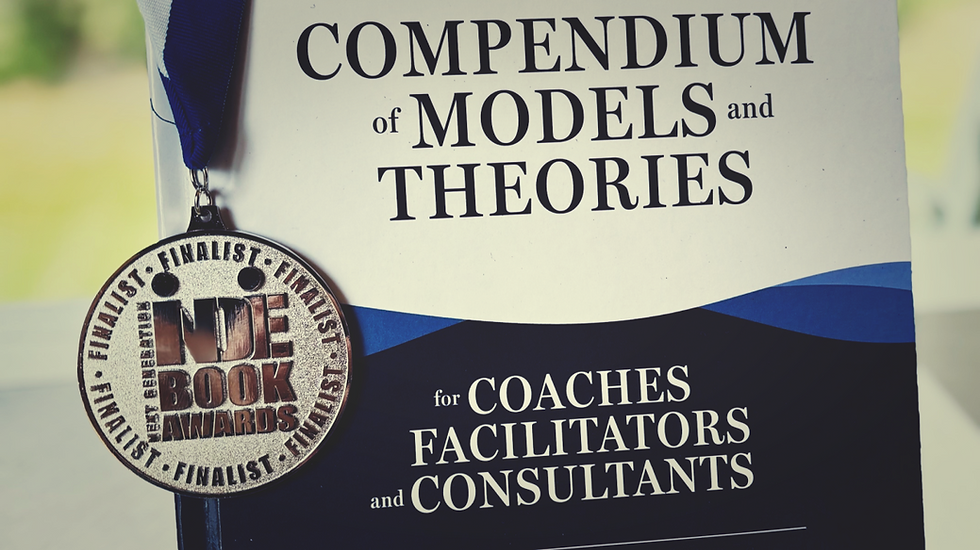
The 4A Model for Stress Management is one of over 300 frameworks across 26 different categories included in the Infourge Compendium of Models and Theories. Next week, we will explore Diffusion of Innovation Theory, a great framework for leadership-level clients preparing for organizational change.
[i] 4 A Model for Stress Management
Conway, A. (2021, March 8). The 4 A’s of stress relief. Retrieved from the Mayo Clinic: https://www.mayoclinichealthsystem.org/hometown-health/speaking-of-health/the-4-as-of-stress-relief
Avram, R. (2017, October 27). The 4 A’s of stress management. Retrieved from the Minute School: https://www.minuteschool.com/2017/10/the-4-as-of-stress-management/
Whitten, H. (2009). Cognitive behavioural coaching techniques for dummies. Wiley.
Sparks, D. (2019, April 24). Mayo mindfulness: Try the 4 A’s for stress relief. Retrieved from the Mayo Clinic: https://newsnetwork.mayoclinic.org/discussion/mayo-mindfulness-try-the-4-as-for-stress-relief/
The 4 A’s of stress management. (n.d.). Retrieved from Pain Scale: https://www.painscale.com/article/the-4-a-s-of-stress-management
The 4 A’s of stress management. (n.d.). Retrieved from Jai Medical Systems: https://www.jaimedicalsystems.com/4-as-of-stress-management/
Singh, A. (2021, March 15). 4 A’s of stress management to cope with stress. Retrieved from Calm Sage: https://www.calmsage.com/practice-4-as-of-stress-management/


Comments